

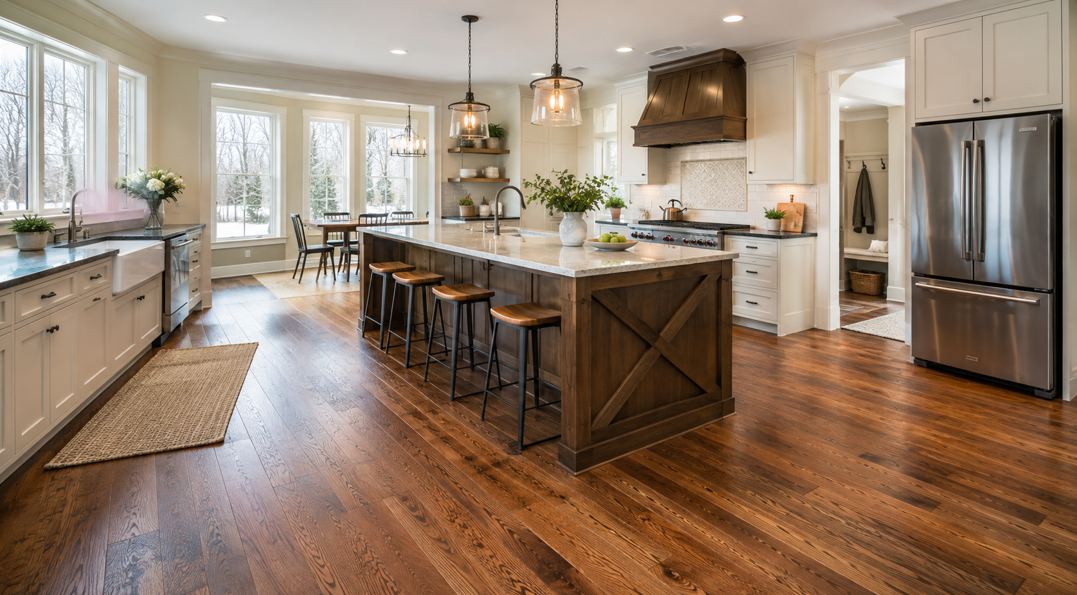
Hardwood can make a Wisconsin kitchen feel warmer, more inviting, and better connected to the rest of the home. Its natural grain softens the look of cabinets, stone countertops, and stainless-steel appliances, while continuous wood flooring can help an open kitchen and living area feel like one thoughtfully designed space.
A kitchen asks more from hardwood than a bedroom or formal dining room. Cooking spills, dishwasher leaks, dropped utensils, chair movement, pet bowls, winter grit, and seasonal humidity changes all affect how the floor performs. Hardwood can work beautifully here, but success depends on product selection, installation, and everyday care.
At Carpetland USA Flooring Center, our 100% employee-owned team has helped homeowners throughout Southeastern Wisconsin and Northeastern Illinois choose quality flooring for more than 25 years. That local experience matters because a Wisconsin kitchen must handle humid summers, dry heated winters, and snow-season moisture.
Can You Put Hardwood Flooring in a Kitchen?
Yes, hardwood can be installed in many kitchens when the product is approved for the space and moisture is managed carefully. Wood reacts to its environment by gaining moisture in humid conditions and losing moisture in dry conditions. Excessive changes may contribute to swelling, cupping, gaps, or splits.
Before choosing a floor, consider:
Whether solid or engineered hardwood better suits the room
The likelihood of spills or plumbing leaks
The type and condition of the subfloor
The household’s cooking, dining, pet, and cleaning habits
Whether the warranty permits kitchen installation
How indoor humidity will be controlled
Most hardwood is not waterproof. A surface finish provides useful protection from ordinary spills, but prolonged water exposure may still damage boards or seams. Current manufacturer guidance confirms that hardwood can work in kitchens when moisture is handled promptly.
The practical answer is simple: hardwood can be an excellent kitchen floor for households prepared to clean spills quickly, maintain stable indoor conditions, and follow the product’s care instructions.
Solid or Engineered Hardwood: Which Works Better?
Both types use real wood, but their construction affects stability and installation options.
Solid Hardwood
A solid hardwood plank is milled from one piece of wood. It offers natural character and may be sanded and refinished multiple times, depending on its thickness and condition.
Solid wood can perform well in above-grade kitchens with suitable wood subfloors. Because it responds more noticeably to changes in temperature and humidity, moisture testing, acclimation, expansion space, and indoor climate control are especially important. Manufacturer guidance identifies dimensional change after installation as a major cause of hardwood problems.
Engineered Hardwood
Engineered hardwood has a genuine wood surface over a layered core. Its construction generally provides greater dimensional stability than solid wood, making many products suitable for kitchens, concrete subfloors, lower levels, and some radiant-heating systems.
Engineered does not automatically mean waterproof. Approval and performance vary by collection, so the product specifications and warranty remain the final authority.
Making the Choice
Engineered hardwood is often the more flexible option for Wisconsin kitchens because it handles normal environmental changes more consistently. Solid hardwood may still be a strong choice for an above-grade room with a compatible wood subfloor.
Ask whether the kitchen is above or below grade, whether the floor will cross onto concrete, and whether radiant heat is involved. Match the construction to the actual home rather than choosing by appearance alone.
Choose a Species and Surface for Daily Kitchen Life
A kitchen floor needs to look beautiful while handling frequent movement. Species, texture, sheen, color variation, and finish all influence how it ages.
Understand Hardness
The Janka rating measures a wood species’ resistance to denting. A harder species can be useful where utensils, cookware, stools, and children’s items may hit the floor.
Hardness does not guarantee scratch resistance or moisture protection. Finish quality, plank construction, maintenance, and household habits also matter.
Oak is popular because it balances visible grain, design versatility, and dependable performance. Hickory offers stronger variation and greater dent resistance, while maple has a smoother, quieter grain. Compare actual samples because appearance and performance vary among products.
Use Texture to Disguise Minor Wear
Wire-brushed and lightly textured surfaces can make fine scratches, crumbs, and small marks less noticeable than a glossy, perfectly smooth floor. They are practical around islands, dining areas, and busy walkways.
Texture still needs routine cleaning. Choose a surface that fits the household’s maintenance preferences as well as the kitchen’s design.
Consider a Lower Sheen
High-gloss hardwood reflects light but often shows footprints, dust, and surface marks more clearly. Low- or medium-sheen finishes tend to create a softer, more forgiving look.
The National Wood Flooring Association explains that all wood floors need finish protection and that the right finish depends on lifestyle and expected wear.
View Color Samples at Home
Mid-tone woods can be forgiving because they do not show every crumb or speck of dust. Light wood can make a kitchen feel open, while deeper browns add warmth and definition.
Place samples beside cabinets, countertops, backsplash, and trim. View them in morning, afternoon, and evening light because Wisconsin’s winter light may make a color look different from its appearance in a showroom.
Compare More Than the Color and Grain
Homeowners exploring hardwood flooring can narrow their options by reviewing these practical details:
Kitchen approval: Confirm that the manufacturer allows installation in kitchens.
Construction: Match solid or engineered boards to the subfloor and home level.
Finish system: Look for protection suited to heavy residential use.
Wear layer: For engineered wood, ask about future recoating or refinishing.
Warranty: Review exclusions involving water, appliances, humidity, pets, and care products.
Installation method: Confirm whether the floor will be nailed, stapled, glued, or floated.
Care requirements: Make sure the recommended routine fits the household.
Do not rely only on labels such as “durable” or “water-resistant.” Ask what those claims cover and which installation and maintenance conditions protect the warranty.
Plan for Water Before Installation
Moisture is the central concern when placing real wood in a kitchen. Prevention begins before the first plank is installed.
Identify the Main Risk Areas
Pay close attention to the sink, dishwasher, refrigerator water line, ice maker, pet bowls, exterior doors, and beverage stations. A professional can look for previous leaks, soft subfloor areas, staining, or unevenness.
Repair Existing Leaks
A slow appliance or plumbing leak may remain hidden until boards swell or discolor. Correct those concerns before flooring work begins.
After installation, check beneath sinks and around appliance connections periodically. Leak alarms may provide additional awareness near dishwashers and refrigerators.
Use Mats Carefully
A breathable, floor-approved mat near the sink can catch minor drips and reduce pivot wear. Avoid rubber or other backings unless the flooring manufacturer confirms compatibility.
Lift mats regularly to clean beneath them and confirm that the floor is dry. A mat protects the surface but cannot compensate for ongoing moisture.
Clean Spills Promptly
The NWFA recommends wiping spills immediately with a dry or slightly damp cloth and avoiding wet or steam mops. Standing water may affect the finish and wood over time.
For an ordinary spill:
Remove solid material carefully.
Blot the liquid rather than spreading it.
Use an approved cleaner if needed.
Dry the area fully.
Check nearby plank edges for hidden moisture.
Prepare the Subfloor and Indoor Environment
Even high-quality hardwood can underperform over a damp, uneven, or unstable base.
Test for Moisture
Wood and concrete subfloors require the testing stated in the product instructions. A surface may look dry while holding moisture below, so visual inspection alone is not enough.
The installer may also need to compare the moisture content of the flooring and wood subfloor. The manufacturer determines acceptable readings, test methods, and vapor-control requirements.
Correct Uneven or Weak Areas
Raised seams, low spots, loose panels, and water-damaged sections can lead to movement or noise. Preparation may involve securing panels, smoothing high areas, filling low areas with an approved product, or replacing damaged material.
Manage Wisconsin’s Humidity Swings
Wood naturally responds to indoor humidity. The NWFA recommends maintaining temperatures between 60°F and 80°F and relative humidity between 30% and 50% to reduce excessive seasonal movement. Follow the selected manufacturer’s range when it differs.
Air conditioning or dehumidification may help during humid summers. A properly managed humidifier may reduce excessive shrinkage during dry heating months. Small seasonal changes can be normal; the goal is to avoid severe, prolonged swings.
Coordinate Cabinets, Islands, and Appliances
Kitchen projects involve several trades, so the installation sequence needs to be agreed on early.
Confirm Whether Flooring Goes Under Cabinets
The answer depends on the hardwood construction and installation method. Floating engineered floors usually need room to move and may not be approved beneath fixed cabinets or islands. Pinning them under heavy built-ins can restrict that movement.
Follow the flooring manufacturer’s installation guide rather than assuming every hardwood floor is installed in the same order.
Protect Appliance Clearance
Floor height can affect whether a dishwasher can slide out from beneath the countertop. Refrigerators, ranges, and other appliances also need level support and enough service clearance.
Discuss finished floor height, dishwasher removal, toe-kick height, transitions, and appliance movement before installation. Use protective panels or approved glides when moving heavy appliances across finished hardwood.
Keep Extra Planks
Several matching boards can make a future localized repair easier. Color may vary between production runs, and the same style may not remain available indefinitely.
Store extra flooring in a climate-controlled area according to the manufacturer’s directions.
Protect the Kitchen’s Busiest Areas
The sink, refrigerator, stove, island seating, and paths to exterior doors usually experience the most wear.
Use Furniture Protectors
Place suitable protectors beneath stools, chairs, movable islands, and freestanding storage. Check them regularly because pads can collect grit or move out of position.
Lift furniture instead of dragging it. Floor protector pads can reduce scratching beneath furniture legs.
Control Winter Grit and Salt
Snow brings moisture, grit, and road salt indoors. These particles may scratch the finish when ground beneath shoes or chair legs.
Use an exterior scraper mat and a breathable interior mat near kitchen entrances. Sweep or vacuum grit before damp cleaning and leave wet footwear near the door.
Protect Pet Feeding Areas
Set bowls on a stable, floor-compatible mat and wipe up water promptly. Lift the mat often so moisture and food debris do not remain against the wood.
Follow a Kitchen-Friendly Cleaning Routine
Wood-floor care works best when it is light, consistent, and matched to the finish.
For daily care:
Sweep with a soft broom or dust mop.
Vacuum using the bare-floor setting.
Remove grit before it is walked across the room.
Blot cooking and drink spills promptly.
Wipe water near the sink, dishwasher, and pet bowls.
For deeper cleaning, use a product recommended for the floor’s finish and follow its label. Avoid soaking the floor. The NWFA advises against wet and steam mops and recommends cleaners designed for the installed finish.
Do not assume a homemade cleaner is automatically safer. Vinegar, oils, waxes, polishes, ammonia, and abrasives may dull or damage certain finishes.
A floor with widespread dullness or surface wear may benefit from professional evaluation. Depending on its condition, recoating may renew the protective finish before wear reaches bare wood. Deep dents, black staining, cupped boards, or loose planks need assessment rather than aggressive spot cleaning.
Common Kitchen Hardwood Mistakes
Avoid these preventable problems:
Choosing a product without confirming kitchen approval
Assuming engineered hardwood is automatically waterproof
Skipping subfloor moisture testing
Installing over unresolved leaks
Ignoring acclimation or expansion requirements
Trapping a floating floor beneath cabinets
Leaving too little appliance clearance
Cleaning with steam or excessive water
Allowing wet mats to remain in place
Dragging stools or appliances
Letting indoor humidity change sharply
Discarding every leftover plank
Professional planning can resolve these questions before materials are ordered and protect the floor’s long-term performance.
Questions to Ask Before Making Your Final Choice
Bring this checklist to the showroom or estimate appointment:
Is this exact product approved for kitchens?
Would solid or engineered hardwood suit my subfloor better?
What moisture tests are required?
What indoor humidity range is allowed?
Does the flooring need acclimation?
Which finish suits heavy kitchen traffic?
What cleaner is approved?
Can the flooring go beneath cabinets and islands?
Will the finished height affect dishwasher removal?
Is the floor compatible with radiant heat?
Can it be recoated or refinished later?
Which water-related events are excluded from the warranty?
How much extra material is sensible for repairs?
Who will coordinate the flooring, plumbing, cabinets, and appliances?
Clear answers make it easier to compare floors on more than appearance.
Create a Kitchen Ready for Wisconsin Life
Hardwood can be a beautiful choice for a Wisconsin kitchen. It brings natural warmth, creates visual flow, and can serve the home for years when the right product is installed and maintained correctly.
A dependable plan combines suitable construction, durable finish, a moisture-tested subfloor, stable indoor humidity, thoughtful appliance clearances, and prompt spill care. It also accounts for the way the household really lives, including children, pets, winter boots, busy meal preparation, and frequent gatherings.
Carpetland USA Flooring Center offers quality products, professional installation, free estimates, and knowledgeable guidance from a 100% employee-owned local team. For help comparing hardwood options for your kitchen, get in touch with our flooring professionals.


